Adora vs PostHog
PostHog was built for engineers. Adora was built for the entire organization.
When analytics and session replay are only accessible to highly technical teams, decision-making becomes siloed and product development slows down. Adora changes that.
Loved by product-obsessed teams


COMPARISON
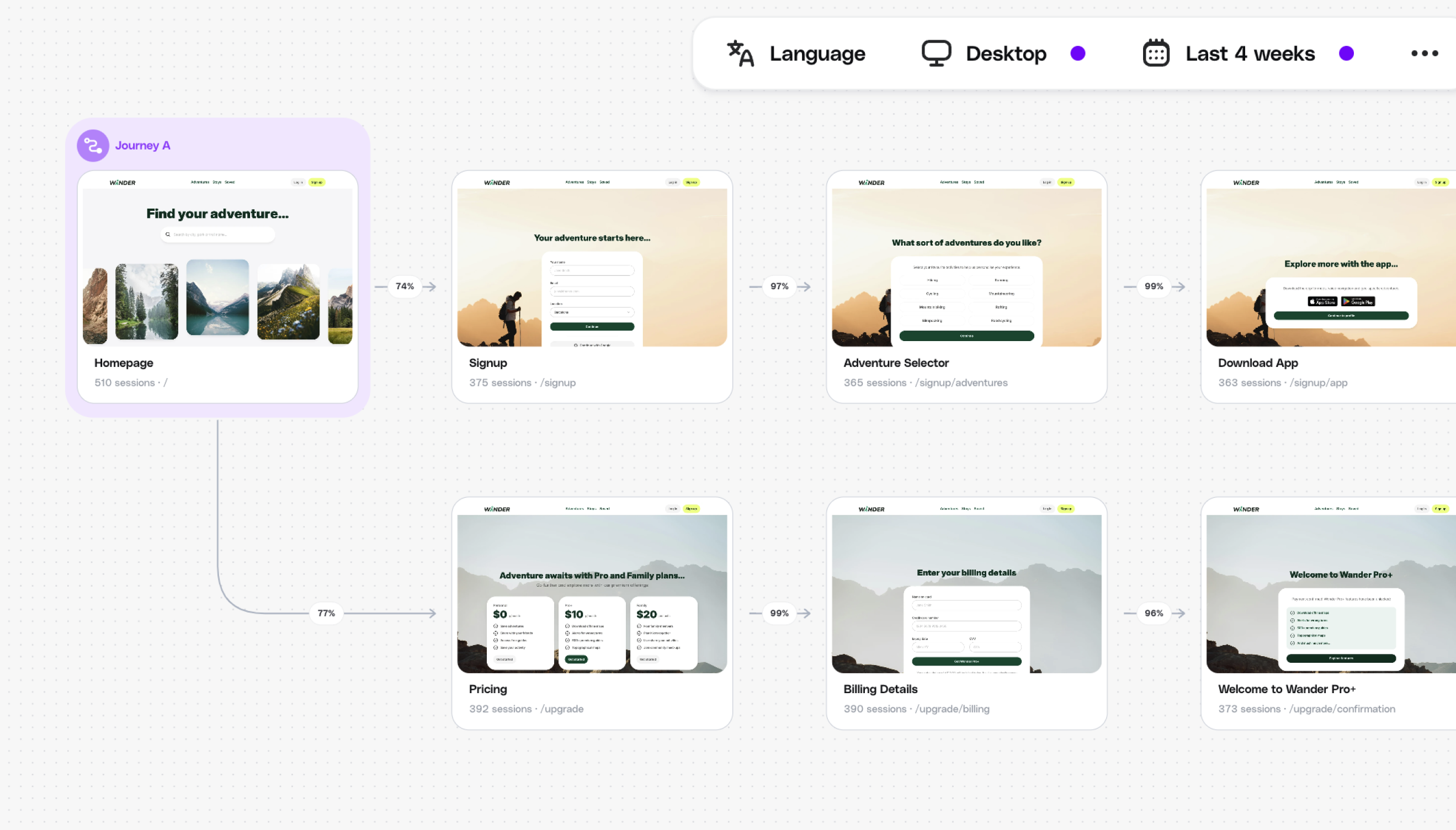
Issues mapped to your user journeys
Unlike PostHog's endless session recordings that require manual searching, Adora automatically analyzes every session and surfaces what matters. You get curated playlists of critical issues, drop-off points, and UX opportunities all mapped to your actual user journeys.
Product Comparison


Automated Journey Mapping
Visual Analytics
AI Insights
Wayback Machine
Living Product Docs
Hosting & Maintenance
We handle everything
Self hosted
Built for
Everyone
Teams of engineers

I save three to four hours every week just from not having to dig for insights. Adora pulls out the needle in the haystack insights.

FAQs
PostHog is an open-source, event-based analytics platform built primarily for engineering teams. It requires defining events, building funnels, and writing queries to get insight from your data — and can be self-hosted for full data control. Adora is a managed visual analytics platform that auto-captures all interactions and uses AI to surface journey maps, friction signals, and prioritised insights automatically. PostHog gives you maximum flexibility and data control. Adora gives you faster time to insight without analyst or engineering support.
No. Adora installs with a single JavaScript snippet — no event taxonomy to design, no tracking calls to write, no schema to maintain. A product manager can install Adora and have automated journey maps and AI-surfaced insights without writing a line of analytics code. PostHog can be set up quickly with autocapture, but getting full value typically requires engineering time to instrument custom events, configure funnels, and maintain the event schema as the product evolves.
Adora is a managed SaaS platform and does not offer a self-hosted deployment option. All data is stored and processed on Adora's infrastructure. Adora is SOC 2 Type II certified, GDPR and CCPA compliant, and masks user inputs by default. If your organisation has strict data residency or sovereignty requirements that mandate self-hosted infrastructure, PostHog's self-hosted option is the more appropriate choice.
PostHog includes a user paths feature that shows common sequences of events, which is a form of path analysis. However, it requires events to be defined and instrumented first, and paths are presented as event-sequence charts rather than visual maps of your product. Adora's automated journey mapping uses AI to cluster all sessions into visual journey patterns without requiring any funnel definitions or event instrumentation.
PostHog's self-hosted open-source version is free to run on your own infrastructure. Their managed cloud offering includes a free tier of up to 1 million events per month before volume-based pricing. Self-hosting eliminates licensing costs but requires engineering time to provision, maintain, and upgrade the infrastructure. Adora's pricing is available at adora.so/pricing.
Yes. Many teams use PostHog for engineering-level event analytics and experimentation, and Adora for product-level visual journey analysis. The two tools address different use cases well enough that they can be genuinely complementary — PostHog answers the technical questions engineers need, Adora answers the experience questions product teams need.