
Product-Led Growth Onboarding Teardowns: B2B vs B2C
Product-Led Growth Onboarding Teardowns: B2B vs B2C
Product-led growth onboarding has become one of the most important levers for activation, retention, and long-term revenue. Whether you are building for businesses or consumers, onboarding is where value is either delivered quickly or lost entirely.
In this blog, we break down two onboarding teardown frameworks. One focused on B2B PLG onboarding and one focused on B2C PLG onboarding. Each teardown visualizes real user journeys across well-known products and highlights what works, what does not, and what teams can learn.
These teardown approaches are designed to help product, growth, and UX teams map onboarding end-to-end and identify opportunities to improve time to value.
B2B PLG Onboarding Teardown
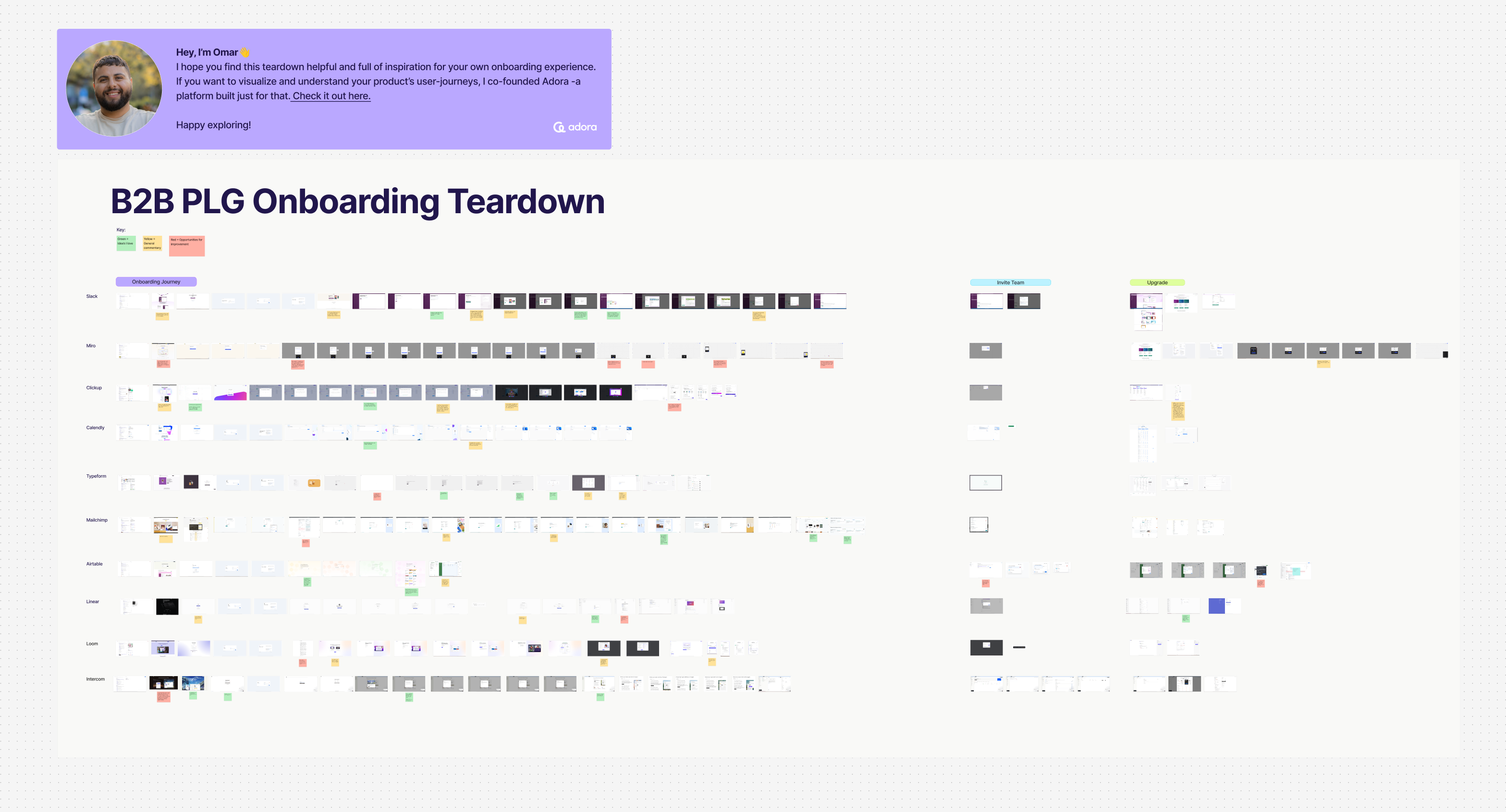
Click here for the link to the teardown!
B2B product-led growth onboarding is complex by nature. Users often represent teams, not individuals, and success depends on collaboration, setup depth, and repeated usage over time.
This teardown focuses on how leading B2B tools design onboarding flows that move users from first touch to meaningful activation.
What the B2B onboarding teardown shows
The B2B teardown visualizes onboarding journeys across multiple SaaS tools and maps:
- Initial signup and account creation
- Workspace or organization setup
- First-run experiences inside the product
- Invite team member flows
- Upgrade and monetization moments
By laying these steps side by side, patterns and gaps become immediately visible.
Common B2B onboarding patterns uncovered
Across the teardown, several recurring patterns emerge:
- Guided setup flows that reduce cognitive load
- Progressive disclosure of advanced features
- Early prompts to invite teammates
- Contextual education embedded directly in the UI
- Clear upgrade triggers tied to usage milestones
These patterns reflect a core B2B reality. Value is rarely delivered in a single session. Onboarding must support a longer journey.
Key challenges in B2B PLG onboarding
The teardown also highlights where B2B onboarding often breaks down:
- Overwhelming users with too many steps upfront
- Delaying the first meaningful outcome
- Treating all users the same regardless of role
- Weak handoffs between self-serve and sales-assisted motions
Teams that fail to visualize the full journey often optimize individual screens instead of the entire experience.
How Adora helps teams improve B2B onboarding
Using a journey-level view like this teardown inside Adora allows teams to:
- Visualize every onboarding step in one place
- Align product, growth, and sales teams on activation goals
- Identify friction points that block team adoption
- Design onboarding paths by persona or use case
B2B onboarding succeeds when the entire journey is intentional, not when individual screens look polished.
B2C PLG Onboarding Teardown
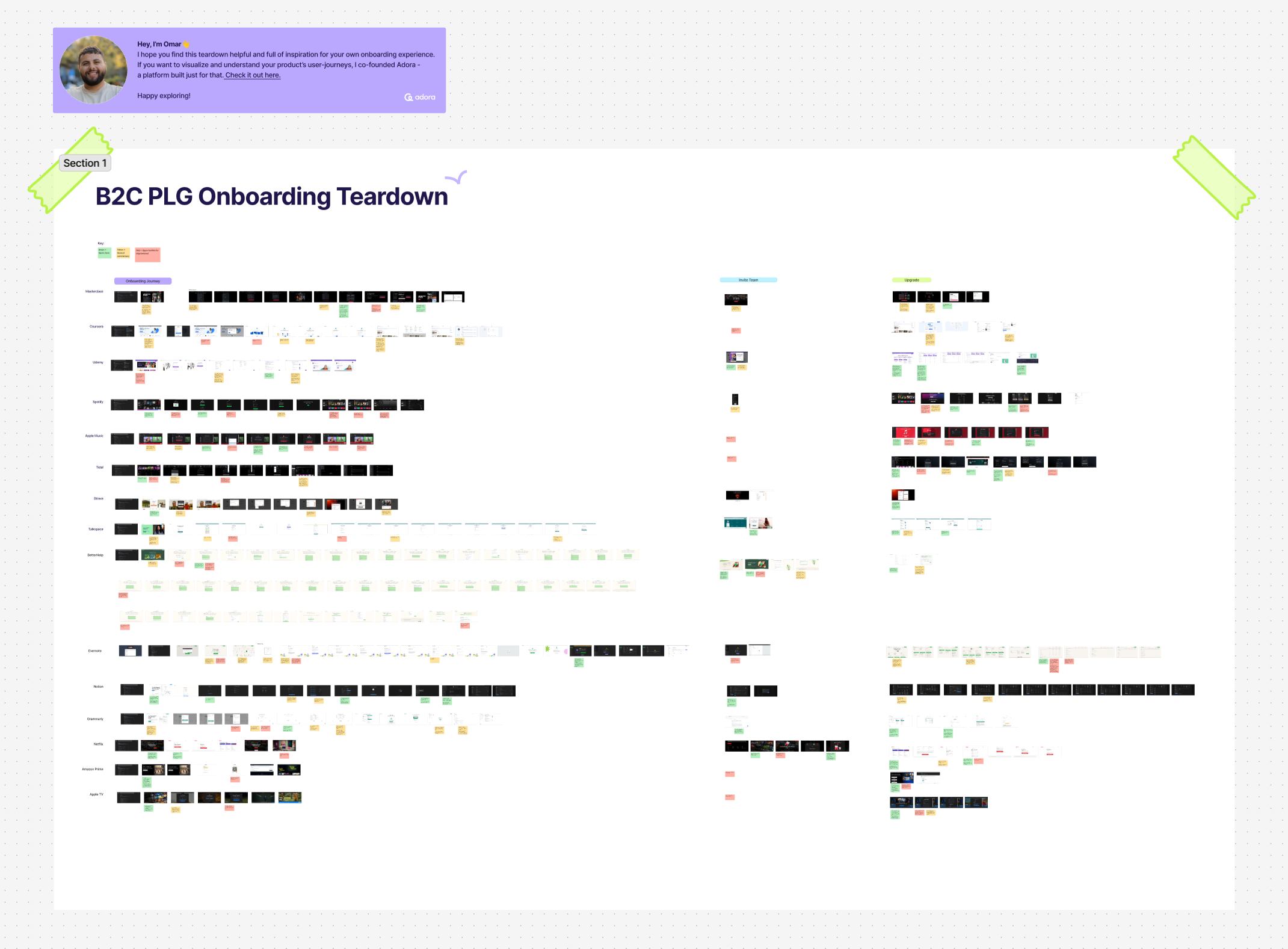
Click here to view the B2C teardown.
B2C onboarding is driven by speed, emotion, and habit formation. Users are quick to abandon products that fail to deliver value almost immediately.
This teardown examines how consumer products design onboarding to hook users early and guide them toward repeated engagement.
What the B2C onboarding teardown shows
The B2C teardown maps onboarding journeys across a wide range of consumer apps, including media, productivity, fitness, and lifestyle products.
It highlights:
- First-launch experiences
- Account creation and personalization steps
- Permission requests and paywalls
- Feature discovery flows
- Early monetization experiments
Seeing these flows side by side reveals how aggressively B2C products optimize for fast activation.
Common B2C onboarding patterns uncovered
Several strong patterns appear across consumer products:
- Immediate value demonstration before asking for commitment
- Minimal input requirements during signup
- Heavy use of personalization questions
- Emotional design and strong visual cues
- Early exposure to premium features
Unlike B2B, B2C onboarding often prioritizes feeling over explanation.
Key challenges in B2C PLG onboarding
The teardown also surfaces common pitfalls:
- Asking for too much information too soon
- Presenting paywalls before value is clear
- Relying on generic tours instead of guided actions
- Failing to connect onboarding to long-term habits
Small frictions matter more in B2C because switching costs are low.
How Adora supports better B2C onboarding design
By visualizing B2C onboarding journeys in Adora, teams can:
- Compare their flows against best-in-class consumer products
- Identify moments of drop-off and confusion
- Design onboarding that supports habit formation
- Experiment with different activation paths and paywall timing
For B2C products, clarity and momentum are everything.
Why onboarding teardowns matter for PLG teams
Whether B2B or B2C, onboarding teardowns help teams move from opinions to evidence. Instead of guessing why users churn or fail to activate, teams can see the entire journey mapped out.
Teardowns enable:
- Better cross-functional alignment
- Faster onboarding experimentation
- Clearer activation metrics
- More intentional product-led growth strategies
Build better onboarding journeys with Adora
Adora is built for teams that want to visualize, analyze, and improve their onboarding journeys. By mapping real user flows like the B2B and B2C teardowns shown here, teams gain clarity on where value is delivered and where it is lost.
If you are serious about product-led growth, onboarding is not a funnel step. It is the product.
Start visualizing your onboarding journeys with Adora and turn insights into action.
Related posts

Why We Built AI Product Insights
The story behind Adora's AI Insights, and why I think this is the future of how product teams operate.

Guide: How to audit your product journeys?
Your product is constantly evolving, and small decisions quietly add up. This is a step-by-step guide to auditing your product journeys, catching friction before it becomes churn, and keeping your whole team accountable to the end-to-end experience.

Data-driven off a cliff: why dashboards are dead
Dashboards are dead. Not because data doesn't matter. But because the way we've been accessing it was never actually built for the people making product decisions. Here's what went wrong, and what comes next.