
The SaaS Product Retention Playbook: Ultimate Guide for SaaS
The SaaS Product Retention Playbook: Ultimate Guide for SaaS
Why is retention important?
Why retention matters
Your product is attracting users, but keeping them engaged is harder than it looks.
Bain & Co found that acquiring a new customer costs 6-7 times more than keeping an existing one. Yet most teams obsess over acquisition while treating retention as an afterthought.
According to research by ProfitWell, companies with strong retention can grow 8x more efficiently than those focused solely on acquisitions.
Why is this the case?
- 💰 Revenue compounds: Retained users generate predictable revenue without the cost of acquisition. They're more likely to upgrade, try new features, and stick around longer.
- 💜 Users become advocates: Happy users don't just stay, they bring others. Word-of-mouth from retained users has a higher conversion rate than any ad campaign and they typically stick around for longer.
- 📣 Feedback gets better: Long-term users understand your product deeply. Their insights shape better features and catch problems before they become widespread.
The best companies aren't just getting more users through the door. They're figuring out how to keep them around and how to make them vocal champions of their product.
When to focus on retention
Retention isn't something you bolt on after launch. It's woven into every stage of your product.
Before product-market fit
You might think retention doesn't matter until you've found product-market fit, but that’s far from the truth.
Retention signals tell you if you're building something people actually need. Watch what brings users back and what makes them leave. These patterns reveal product-market fit faster than vanity metrics.
Do this early:
- Ask users: "How disappointed would you be if you couldn't use this product anymore?" If less than 40% say "very disappointed," you haven't hit PMF yet.
- Track which actions correlate with users returning. That's your retention signal and how can you educate more users to use your product in these ways.
- Talk to churned users. They'll tell you exactly where the product fails to deliver value, helping you shape your product to be a high value experience everyone love.
During product development
This is where retention gets built in, not tacked on.
Slack didn't accidentally achieve 98% retention among paid teams. They designed features like channels, threads, and integrations to become more valuable the longer you use them.
Your product should work the same way.
Ask yourself:
- What makes your product stickier over time?
- What benefit do people get from returning to your product?
- What task/pain-point or goal can people achieve when returning?
If the answer is "nothing," you have a retention (and product) problem before you even launch.
After launch
This is where the real work begins.
Launch gets the attention, but retention is what brings in the ARR. Every percentage point of retention you improve can translate to millions in ARR. A 5% increase in retention can double your revenue growth over time.
The difference between companies that scale and those that stall often comes down to how seriously they take post-launch retention.
Build retention into the product
The best retention strategies aren't marketing campaigns, they're product features and experiences.

Duolingo, the language learning app, is a masterclass here. They don't just track retention, they actively shape it through:
- Daily streak mechanics that incentivise users to keep using the app daily
- Personalized learning paths that adapt to individual progress
- Social competition between friends and with leaderboards that creates accountability
These aren't add-ons. They're core to the product experience, designed specifically to bring users back.
Your product should work the same way. What features make your product more valuable the longer someone uses it? What creates natural reasons to return?
Track retention at every step
If you can't measure it, you can't improve it.
Set up the infrastructure to monitor retention across your entire product journey. Not just top-line metrics, but specific journey-level retention:
- Which onboarding paths lead to better retention?
- What features correlate with users sticking around?
- Where in the product experience do users drop off?
- What cohorts of users are dropping off (eg. mobile or desktop )?
The teams that win are constantly testing, learning, and iterating on what keeps users coming back. Your post-launch retention work should be just as deliberate.
Retention definitions
Here’s your cheatsheet for common language used when talking about retention.
Core retention metrics
- Customer Retention Rate (CRR): The percentage of users still active after a set period. If 100 users sign up and 40 are still active after 30 days, that's 40% retention.
- Churn Rate: The flip side. The percentage of users who stop using your product. If retention is 40%, churn is 60%.
- Product Usage Interval: How often users naturally need your product. Daily for Slack, weekly for Notion, monthly for tax software. Know yours.
- Customer Lifetime Value (LTV): Total revenue a user generates before churning. Higher retention directly increases CLV.
- Retention Curve: A graph showing user activity over time. A flattening curve means you've found sustainable retention. A curve that keeps dropping means you're losing users indefinitely.
- Activation Metric: The specific user action that signals they’ve reached the aha moment and experienced real value. Slack's growth team discovered that teams exchanging 2,000 messages had hit their "aha moment." Facebook found that users adding 7 friends within 10 days were far more likely to become daily active users. Every product has one—your job is finding it.
- CSAT (Customer Satisfaction Score): A simple metric that asks users "How satisfied are you with [product/feature/experience]?" typically on a 1-5 or 1-10 scale. It measures immediate satisfaction with a specific interaction rather than long-term loyalty. Note: to track this you need to sent our a survey, this is not calculated from product metrics.
- NPS (Net Promoter Score): Is a customer loyalty score based on your users answering the question “On a scale from 0 to 10, how likely are you to recommend this product/company to a friend or colleague?”. Note: to track this you need to sent our a survey, this is not calculated from product metrics.
- DAU/WAU/MAU (Daily/Weekly/Monthly Active Users): The number of unique users who perform a meaningful action in your product within a day, week, or month. Which one to track matters depends on your product's natural usage pattern, Slack tracks DAU, where as Tax software may only track MAU or even quarterly usage.
- N-Day Retention: Retention measured at specific intervals (Day 1, Day 7, Day 30, Day 90). Each tells a different story about your product's stickiness.
- Net Retention (NRR - Net Revenue Retention): Measures revenue growth from your existing customer base, accounting for upgrades, downgrades, and churn. If you start the year with $100K from a cohort and end with $120K (after expansions minus churn), your NRR is 120%. Above 100% means your existing customers are growing in value faster than you're losing revenue to churn.
What are the different types of users in your product?
- New Users: People who have just signed up. They're evaluating if your product solves their problem or goal.
- Active Users: People who are regularly using your product returning daily (DAU, weekly or monthly. They've found value and integrated it into their workflow.
- Power users: People who use your product frequently and generate the most value, both for themselves and your business. Analysing their behavior, use cases, and feature adoption patterns reveals what drives deep engagement.
- Dormant Users: People who haven't used your product in a defined period. They're at risk of churning but still recoverable.
- Churned Users: People who have stopped using your product entirely. They may have canceled, deleted their account, or simply never returned. Understanding why they left helps prevent future churn.
- Resurrected Users: Previously dormant users who came back. Understanding what brought them back is key to resurrecting other dormant users.
How to measure retention
Effectively measuring your retention helps you track and optimize your product experience in a meaningful way.
🏃 Step 1: Define what "active" means
This varies by product. For Slack, active might mean sending a message. For Netflix, it's watching content. For Figma, it's exporting a design.
Pick the action that best represents core value delivery. Don't pick vanity metrics like "logged in”, pick actions that matter and show that the user derived value from your product.
🗓️ Step 2: Choose your time frame
Track multiple windows:
Day 1 retention: Did users come back the next day? This measures immediate value.
Day 7 retention: Did they return within a week? This shows if they're forming a habit.
Day 30 retention: Are they still around a month later? This indicates product stickiness.
Day 90+ retention: Have they truly integrated your product? This predicts long-term retention.
To calculate this metric:
Retention rate = (Users active at end of period) / (Users active at start of period) x 100
Don't just look at one window. Each tells a different story.
👥 Step 3: Segment by cohorts
Group users by when they signed up or by behavior patterns. This lets you see if recent product changes improved or hurt retention.
For example:
- Users who signed up in January vs. February
- Users who completed onboarding vs. those who didn't
- Users from different acquisition channels
- Users from different countries
Cohort analysis shows you what's working and what's not and helps you pinpoint certain user groups that are working well or need a helping hand.
⤴️ Step 4: Identify your retention curve
Plot retention over time. You want to see the curve flatten, meaning you're retaining a stable percentage of users long-term.
If your curve never flattens, you have a fundamental product problem. Users aren't finding lasting value.
How to improve retention
Different user segments need different approaches.
👋 New users: Get them to value fast
The first session is critical. Most users decide if your product is worth their time within seconds or minutes.
- Personalize onboarding: Shopify asks what you're selling before showing you features. Notion asks what you want to build. Tailor the experience to user intent.
- Drive to the 'aha moment': Identify your critical event and guide users there fast. Don't bury it behind tutorials or features that are irrelevant.
- Remove friction: Every extra step in onboarding is a chance to lose users. Cut ruthlessly.
- Use qualitative research: Talk to new users. Watch session replays and find where they get stuck or confused.
- Rigorously analyse the sign up and onboarding journey: To spot drop offs, areas for improvement or places where people get lost.
🏃 Active users: Deepen engagement
Don't take active users for granted. Keep giving them reasons to return.
- Suggest relevant features: Show users features they haven't tried but would find valuable. Canva does this well with template suggestions based on the type of design the user is creating.
- Launch new capabilities: Give users reasons to explore your product again.
- Create variable rewards: A variable reward is something that changes in the product and lures the users back in. For example Spotify's Discover Weekly playlist arrives every Monday. Users return to see what's new. Or in a tool like Adora, users return to see new user sessions and insight on how they can improve their user journeys.
- Build streaks and milestones: Duolingo's streak system keeps users coming back daily. Progress tracking creates momentum.
- Monitor feedback channels: Your active users will tell you what they need or long for in the product. Listen to them and prioritise your roadmap accordingly.
😬 At-risk users: Catch them before they churn
Some users are slipping away. Catch them early.
- Build churn prediction models: Identify behaviors that precede churn (declining usage, dropping key features, not using certain features or taking certain behaviours etc.). Intervene before they leave.
- Run reengagement campaigns: Reach out when usage drops. Show them what they're missing or what's new.
- Offer incentives: Sometimes a well-timed discount or feature unlock brings users back.
🔥 Churned users: Win them back
Don't write off churned users completely. Many can be recovered.
- Understand why they left: Survey churned users. Their feedback is brutally honest and incredibly valuable to your product offering.
- Target them with solutions: If they churned because of missing features, reach out when you ship those features.
- Optimize cancellation journeys: Offer alternatives before they cancel, downgrade options, pause features, or temporary discounts. Prime Video will offer you discounted subscriptions as you try to cancel in order to retain you in the product.
Retention Case Studies
Let's look at companies that cracked retention.
Duolingo: Building daily habits through gamification
Duolingo turned language learning into a game that hooks users and keeps you coming back.
Their retention mechanics:
- Streaks: Miss a day and lose your progress. This loss aversion is powerful.
- XP and leaderboards: Get XP (points) for completing lessons or practice that contributes to your position on the weekly social leaderboard.
- Personalized difficulty: Lessons adapt to your level, helping you learn in a way that’s cater for you no matter if you’re a beginner, or pro.
Result: 55% of users return daily after hitting a 7-day streak. That's exceptional for an education app. Duolingo has an interesting blog on their growth model here.
Slack: Engineering the 'aha moment'
Slack discovered that teams sending 2,000 messages rarely churned. That became their North Star.
Their founder says: “Based on experience of which companies stuck with us and which didn't, we decided that any team that has exchanged 2,000 messages in its history has tried Slack — really tried it,” Butterfield says. “For a team around 50 people that means about 10 hours’ worth of messages. For a typical team of 10 people, that’s maybe a week’s worth of messages. But it hit us that, regardless of any other factor, after 2,000 messages, 93% of those customers are still using Slack today.”
They redesigned onboarding to push teams toward that milestone:
- Pre-populated channels with conversation starters
- Encouraged inviting teammates immediately
- Sent timely prompts to drive usage
Netflix: Content personalization for continued viewing
Netflix's retention strategy is simple: make it impossible to run out of things to watch.
Their approach:
- Algorithmic recommendations: 80% of content watched comes from recommendations.
- Auto-play next episode: Reduces friction to continue watching.
- Personalized thumbnails: Different users see different artwork for the same show based on what catches their attention.
Result: Netflix maintains some of the highest retention rates in streaming at 98%, with most users staying subscribed for years.
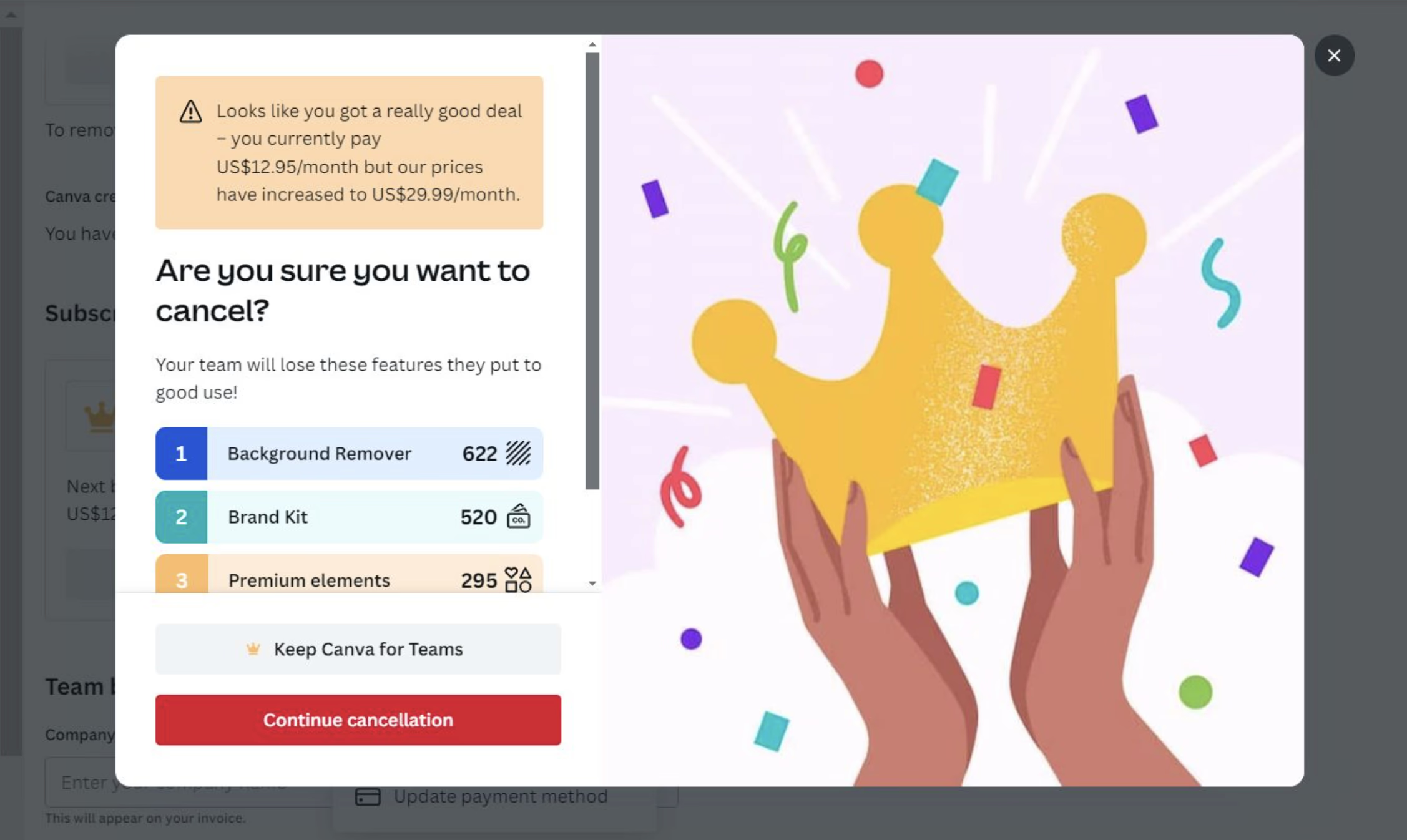
Canva: Loss aversion
Canva doesn't let users slip away quietly.
When a paying user goes to cancel their subscription, Canva quantifies how much value they’ve got from the subscription and shows them what they’ll be missing out on. This leads to high numbers of user retaining their paid subscription.
You’re a retention expert now!
There you have it, your step by step guide for how to:
- Understand why retention is important
- Learn the language and definitions of retention
- Learn how to measure retention
- See how the best companies are winning from retention strategies
I hope you found this guide helpful 💜
Related posts

Why We Built AI Product Insights
The story behind Adora's AI Insights, and why I think this is the future of how product teams operate.

Guide: How to audit your product journeys?
Your product is constantly evolving, and small decisions quietly add up. This is a step-by-step guide to auditing your product journeys, catching friction before it becomes churn, and keeping your whole team accountable to the end-to-end experience.

Data-driven off a cliff: why dashboards are dead
Dashboards are dead. Not because data doesn't matter. But because the way we've been accessing it was never actually built for the people making product decisions. Here's what went wrong, and what comes next.