Conversion Rate Optimization with AI Journey Mapping
Conversion Rate Optimization with AI Journey Mapping
Conversion rate optimization (CRO) has traditionally been about testing page elements: button colors, headline copy, form fields, CTA placement. That approach works for simple pages. For products with multi-step conversion flows, it misses the bigger picture.
The bigger picture is the journey. A user who reaches your pricing page from a case study has different context than one who arrives from a Google search. A user who has explored three features before clicking "Upgrade" is in a different mental state than one who saw a modal popup. The path to conversion shapes the conversion decision.
AI journey mapping brings CRO from page-level optimization to journey-level optimization. Instead of asking "which button color converts better?", you ask "which user journeys lead to the highest conversion rates, and how do we get more users onto those paths?"
Why page-level CRO plateaus
If you have been doing CRO for any length of time, you have probably noticed diminishing returns. You tested the headline, improved it by 12%. Tested the CTA copy, gained another 5%. Simplified the form, another 3%. Each test gets smaller improvements.
This is normal. Page-level optimizations have a ceiling. You can only make one page so good. The bigger gains come from what happens before and after that page, which is the journey.
Research from Forrester's CX Index consistently shows that optimizing end-to-end customer journeys drives significantly more revenue impact than optimizing individual touchpoints in isolation. That makes intuitive sense: the journey is the full context, the page is one moment within it.
The Journey Context Effect
Consider two users who both land on your pricing page:
User A: Arrived via organic search for "project management pricing." Visited your homepage, bounced around features for 2 minutes, and clicked "Pricing." They are comparison shopping. Conversion probability: low.
User B: Signed up for a trial 5 days ago. Completed onboarding. Created 3 projects. Invited 2 teammates. Used the product daily. Clicked "Upgrade" from inside the product. They already know the value. Conversion probability: high.
Same pricing page. Radically different conversion potential. Page-level CRO treats both visitors identically. Journey-level CRO optimizes for each path separately.
How AI journey mapping changes CRO
1. Different paths to conversion
Traditional CRO analyzes one conversion funnel. Where’s as real uses take a multitude of different journeys to arrive at the point of conversion.
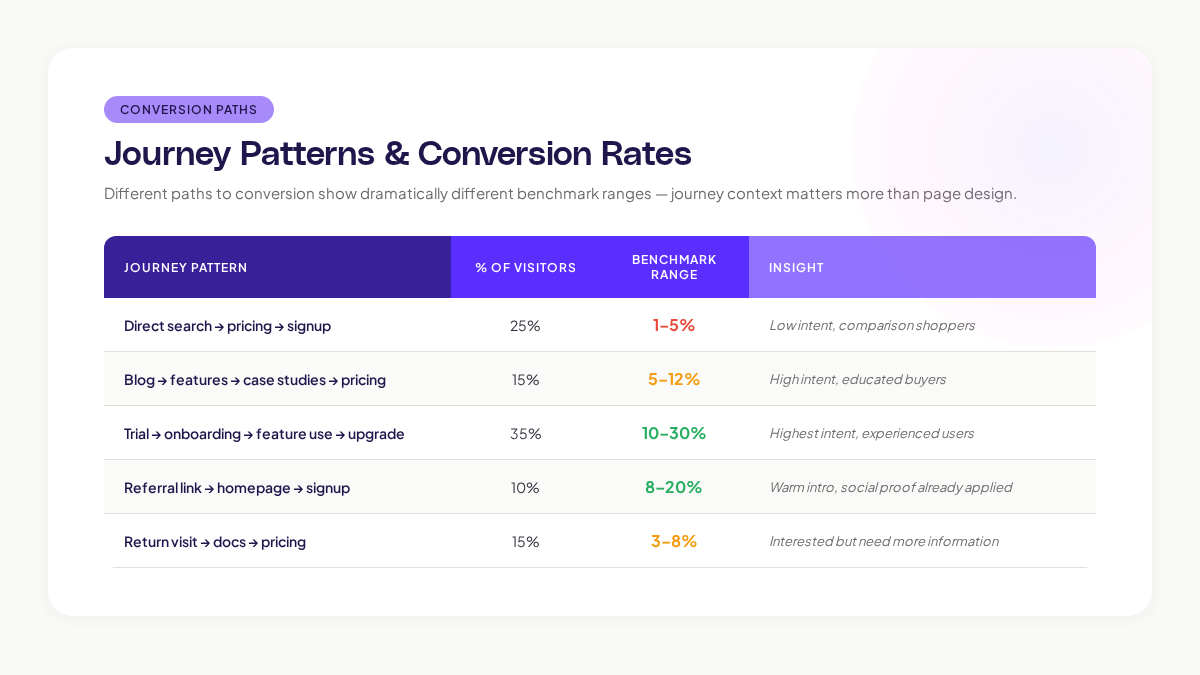
Once you see these patterns, your CRO strategy shifts from "optimize the pricing page" to "get more users onto the high-converting paths."
2. Identify friction in the journey
AI journey mapping helps you spot where people get stuck on the way to converting. Here are a few common signals, and what they usually mean:
- Rage clicks on the pricing page: People are confused by the pricing tiers, or cannot find the information they need.
- Bouncing between Features and Pricing: People are trying to figure out which plan includes the feature they care about.
- Detours into help docs mid-flow: The conversion flow does not answer key questions, so people go looking for clarity.
- Checkout drop-off after entering payment details: Last-minute doubts, surprises, or hidden costs show up.
When you see a signal, it points to a specific fix. Rage clicks usually mean clearer pricing and plan explanations. Loops between Features and Pricing usually mean better feature-to-plan mapping. Help doc detours usually mean the flow needs more guidance inline.
Baymard Institute's checkout UX research found that 17% of checkout abandonment is caused by a checkout that feels "too long or complicated." Journey data helps you pinpoint exactly which steps feel too long or too complicated.
3. Improve what happens before the conversion page
Some of the highest-impact CRO work happens before someone ever reaches pricing or checkout. If people show up already convinced, the conversion page has a much easier job.
Look at what high-converting users do before they hit the conversion point:
- Which pages do they visit? (The content that builds confidence)
- How long do they spend? (More time often means higher intent)
- Which features do they use during trial? (The moments that make the value click)
- Do they engage with social proof? (Case studies, testimonials, reviews)
Then design the journey so more users naturally get those same confidence-building experiences. That is journey-level CRO.
A framework for journey-based CRO
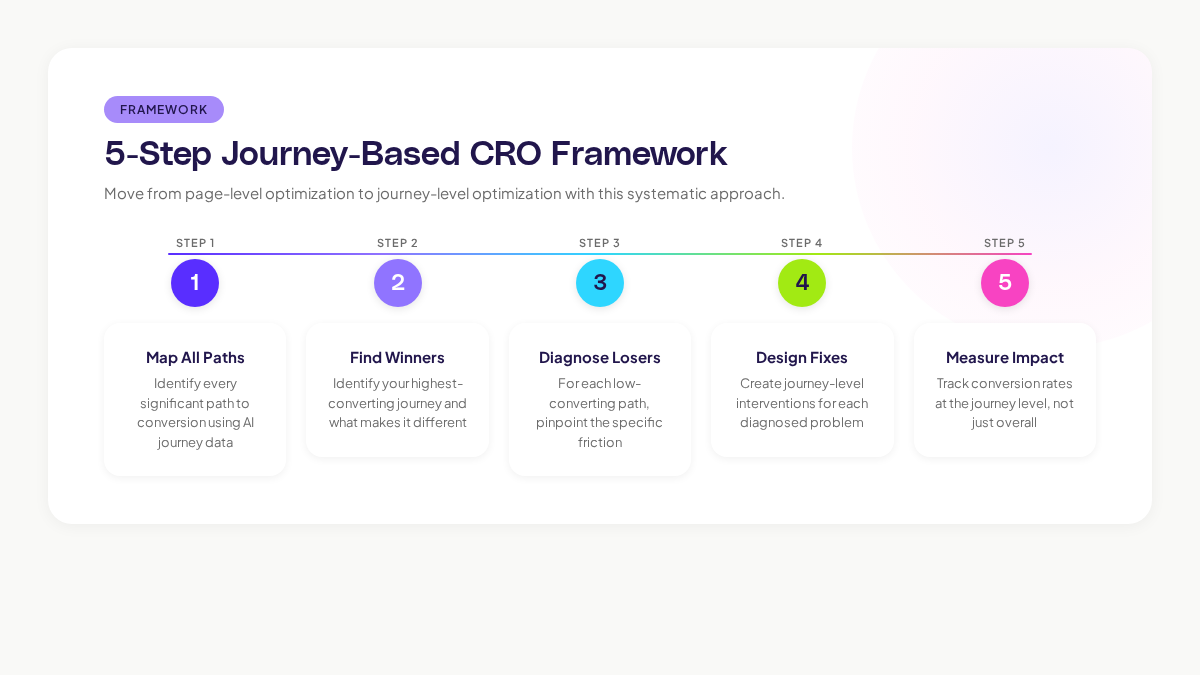
Step 1: Map All Conversion Paths
Use AI journey data to identify every significant path to conversion. Rank them by volume and conversion rate.
Step 2: Identify Your Highest-Converting Journey
Which journey pattern has the highest conversion rate? What makes it different? Understanding this journey is your foundation.
At Canva, we found that users who shared a creation with someone before encountering the upgrade prompt converted at 4x the rate of users who had not shared anything. Sharing was the key pre-conversion behavior that demonstrated value and created social investment.
Step 3: Diagnose Low-Converting Journeys
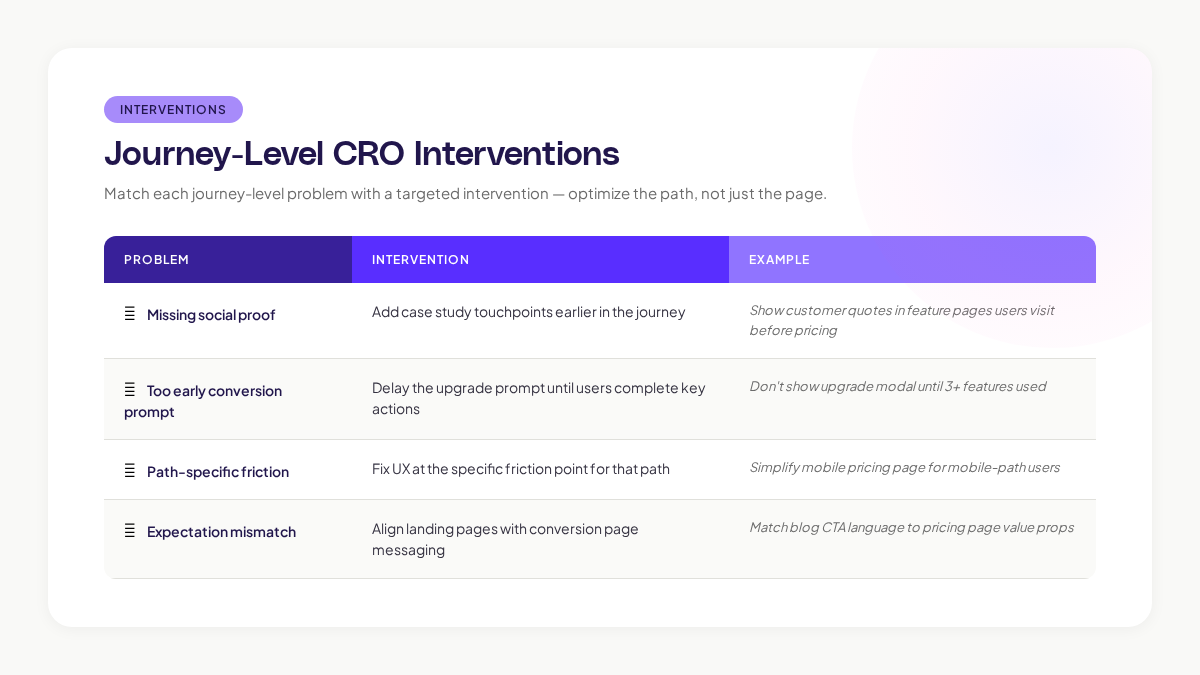
For each journey pattern with below-average conversion, diagnose the specific problems:
- Missing information: Users on this path do not encounter enough social proof or feature education before conversion
- Wrong timing: Users hit the conversion point before they are ready (too early in their product experience)
- Friction at the wrong moment: Technical or UX problems on this specific path
- Mismatched expectations: Users arriving from a specific channel or content piece have expectations the conversion page does not meet
Step 4: Design Journey-Level Interventions
For each diagnosis, design an intervention that addresses the journey-level problem:
Step 5: Measure Journey-Level Impact
After implementing changes, measure impact at the journey level:
- Did the conversion rate for the targeted journey pattern improve?
- Did the overall conversion rate improve?
- Did the change affect other journey patterns? (Positive or negative spillover)
- Did behavioral signals (friction, drop-offs) decrease along the targeted path?
Advanced CRO techniques with journey data
Segment-Specific Conversion Optimization
Different user segments convert at different rates on the same journey. Build segment-specific CRO strategies:
- By company size: Enterprise prospects need more social proof and security information. SMBs need faster, simpler conversion flows.
- By acquisition source: Organic search visitors need more education. Referral visitors need less convincing and faster paths to action.
- By product experience: Trial users with high engagement need minimal selling. Trial users with low engagement need re-engagement before conversion.
McKinsey's research on personalization found that personalized conversion experiences drive 10-15% revenue uplift. Journey data makes personalization precise by showing you exactly how each segment navigates.
Multi-Touch Attribution Through Journey Data
CRO is not just about the last click. Journey data shows you every touchpoint that contributed to the conversion decision. You can identify which content, features, and interactions most strongly predict conversion and invest more in those touchpoints.
Time-Based Conversion Analysis
Some users convert quickly (within a day). Others need weeks. Analyze conversion journeys by time dimension:
- How many sessions does the median converter have before converting?
- What happens in the sessions between first visit and conversion?
- Is there a "decision window" where conversion probability peaks?
Google's research on the customer decision journey shows that B2B purchase decisions involve an average of 6-10 research interactions before conversion. Understanding the full sequence helps you optimize each touchpoint.
Case study: journey-based CRO in action
Here is a hypothetical scenario that illustrates journey-level CRO in action:
Imagine a workflow automation tool where traditional CRO efforts (pricing page tests, checkout simplification, email sequences) have plateaued.
What journey analysis might reveal:
- Users who build multiple workflows during trial convert at significantly higher rates than those who only build one
- There is a clear behavioral threshold: users who get past a certain level of product engagement are far more likely to convert
- The issue is not the pricing page. It is that most trial users never build enough workflows to see the product's real value
Journey-level interventions this suggests:
- Add guided workflow templates to reduce time-to-first-workflow
- Prompt users to create additional workflows after their first success
- Delay the upgrade prompt until users have demonstrated meaningful engagement
The improvement in this scenario comes entirely from journey-level optimization, not from changing anything on the conversion page itself.
Conversion rate optimization that stops at the page level leaves the biggest improvements on the table. The journey to conversion shapes the conversion decision more than any single page element.
AI journey mapping enables journey-level CRO by showing you all paths to conversion, the behavioral context along each path, and the friction points that prevent conversion.
Start by mapping your conversion paths. Find your highest-converting journey. Understand what makes it work. Then engineer more users toward that journey and fix the friction on your lowest-converting paths.
Adora gives product and growth teams the journey data they need for precision CRO, with automated path mapping and AI-powered behavioral signals that flag conversion friction automatically.
Related posts

Why We Built AI Product Insights
The story behind Adora's AI Insights, and why I think this is the future of how product teams operate.

Data-driven off a cliff: why dashboards are dead
Dashboards are dead. Not because data doesn't matter. But because the way we've been accessing it was never actually built for the people making product decisions. Here's what went wrong, and what comes next.

SaaS Pricing Pages to Sign Up Journeys
This teardown analyzes SaaS pricing pages and their connected sign up journeys. Learn how leading SaaS companies design pricing, CTAs, and sign up flows that reduce friction and increase conversion.